by Robert Greene
Laws 6-13
Apparently, during the year that I spent in Japan The 48 Laws of Power became extremely popular, especially among those in the hip-hop community. This was all news to me, particularly since I'd bought the book about six months before I left the States and hadn't found it terribly interesting. I'd made it to Law 5 ("So Much Depends On Reputation - Guard It With Your Life") and decided that I could wait until I returned from Japan to finish it. Well, I'm back now and I'm determined to finally finish it. Strangely enough, I'm finding it more interesting reading the second time around, but maybe not for the reasons that have made it so popular.
I'm less interested in the Laws themselves than I am in the history that Greene uses to illustrate those laws. Even if I do think that most of the Laws are little too cutthroat for my idealistic tastes, I love reading about the disastrous love affairs of Lola Mendez, the double-dealings of Talleyrand, and the gullibility of Al Capone. The only explanation I have for this is that, having studied Classical Civilization for four years, it makes sense that I would find the story of the Corinthian and Corcoran ambassadors at Athens more interesting and, to me at least, more informative than the law itself ("Law 13: When Asking for Help, Appeal To People's Self-Interest - Never To Their Mercy Or Gratitude").
As for the Laws themselves, well I've already stated that I think I'm a little too idealistic to fully appreciate their feasibility and usefulness. There are certainly some Laws I can appreciate ("Law 10: Infection: Avoid The Unhappy And The Unlucky" and Law 13: (see above) for instance). But most of the Laws I find too ambiguous and too dependent upon your own particular situation and the people with whom you are dealing to be of any use at all. Few of any of the laws are infallible. In fact, the only one that is infallible so far is Law 10 (see above) according to Greene himself.
The one thing that Greene has managed to impress upon me so far is something I knew before I even picked up the book. That is that attaining and keeping power is difficult, arduous, and, at times, dangerous work. I can understand the reasons why someone would like to have the kind of power that Greene discusses in the 48 Laws. After all, we all like to have at least a little power over ourselves and others. But to attain the kind of power it takes to reach "Master" status just seems like too much manipulative, unhappy work to me. There never seems to be a point at which you're allowed to just enjoy your life and your position. During Law 11 ("Learn To Keep People Dependent On You") Greene writes, "You cannot rest at ease, and what good is power if it brings you no peace?" Amen, Greene. Amen. That's the kind of law I can get behind.
Sunday, December 24, 2006
The 48 Laws of Power


How to Sail Across the Atlantic
by Paul Bennett
from The Best American Travel Writing 2006
Out of all of the great images and lessons on sailing around the world Paul Bennet presents in "How to Sail Across the Atlantic," this image sticks with me the most: On trying to remove an obstruction in their boat's plumbing he writes, "As I pulled the hose free from the valve...(I)n the next moment, the obstruction in question shot out the line with fire-hose ferocity. It caked the walls, the ceiling, and the floor. It covered me completely from head to toe. I can say, unequivocally that being showed with another person's crap has been the single worse experience of my life." It sounds like something from a gross-out comedy movie: both funny and disgusting at the same time. It might also be a part of the reason why I enjoyed this selection.
Besides learning how not to repair the plumbing on a boat, Bennet divulges many other valuable lessons such as pirates are still real, tankers can come out of nowhere and split your boat in half in a second, on average, it takes amature sailors four and half years to circumnavigate the world, and whales are just as dangerous as sharks in the open water. Despite all of that, it all still sounds hopelessly romantic to me. I just returned from my first cruise a week ago, and there is definately something to said for being able to look out your window and see nothing but blue, blue ocean. I bet it is scary, expensive, and exhausting to set sail around the world but the rewards - the sights you'd see, the things you'd do along the way - would be well worth it. I love a good adventure.
The Selling of the Last Savage
by Michael Behar
from The Best American Travel Writing 2006
How can you not like a selection that begins with a sentence like this: “I’m somewhere in a godforsaken rain forest on the north coast of West Papua, Indonesia, and I’m ready to get the hell out of here.” Talk about gripping. The rest of Behar’s account is no less so as he recounts his experiences on an expedition called First Contact, an exploratory trek in West Papua in which participants attempt to make contact with tribes who have never seen outsiders. Several times throughout the piece, Behar questions whether First Contact is a hoax. We’re never entirely sure if it is, mainly because, even after all that he experiences on the trek, Behar is never entirely sure himself. One thing Behar is sure of though is his very real fear when, at one point, members of a native tribe rush out of the bush shooting arrows above his head. If it is a hoax, it is apparently very well done.
Besides the question of whether there are even “uncontacted” tribes left to be discovered, Behar questions whether it’s even ethical to “contact” these tribes if there were. At one point during the expedition, Behar says, “That’s when I notice that their hands are trembling. They look absolutely terrified. A wave of guilt washes over me…‘We shouldn’t be doing this. They’re really freaked out.’” Is it ethical to seek out remote jungle tribes just for the cheap thrill – if $8, 000 a pop could be considered cheap – of getting a peek at a people never seen before? Consider this: What if you, living the way that you do, eating the way that you do, were the out-of-date oddity (Brave New World anyone?)? How pissed off and terrified would you be if some scary-looking stranger invaded your home, inspected your life, and took pictures to show the amazed family back home? I don’t know about you, but I think a lot of people might do what some West Papuans do: shoot first and ask questions later.
At one point during the expedition, Kelly Woolford, the creator and leader of First Contact, says to Behar, “Papuans are scared of the unknown.” The question is: At the end of the day, aren’t we all?

Saturday, December 23, 2006
Megan's Mark, pt. 2
by Lora Leigh
pgs. 242-295 (End)
Lora’s Leigh’s books are the kind that I wish I could hide when I have company. The problem is I have too many of them to hide. I have serious, plentiful problems with Megan’s Mark, a few of which I’ve already included in my first entry on this book, i.e. annoying female, cardboard male, and a predictable plot. I could point out a few other problems I found within the last quarter of the book.
For instance, why would a deputy sheriff living in a small, remote desert town need “an impressive display of weapons and ammunition” that includes items that not even members of the Navy SEALS posses? Why would Megan have trained in the canyons with her military family members since she was a child? Were they expecting some war on the home front Leigh hasn’t told us about? Maybe Leigh wants us to believe that that’s what people who live in remote, desert towns do: collect expensive weaponry and train at the age of infancy to prepare for the coming Armageddon. I would have thought that that’s just a stereotype but then I’ve never been to a remote town in the desert, so what do I know?
And who in the world edited this book? I’m generally willing to ignore certain egregious typographical and consistency errors in eBooks such as the ones published on ellorascave.com. The same cannot be said for books published in hard copy. I would think that editors working in hard copy production would be a little more diligent than those in eBook publishing simply because it’s much easier (and cheaper) to correct a mistake in electronic format. The editor working on this book must have been asleep. I don’t know about anyone else but I get annoyed when I read that a character is sitting one moment and suddenly standing in the next with no transition whatsoever. That’s just sloppy writing and sloppy editing.
Yet, and here’s the clanker, I know I’ll be chucking out another $6.99 for the next installment in three months. Two of the things at which Leigh excels, is creating enigmatic secondary characters and mysteries set within the existing plotline which are seductive enough to hook poor readers like myself. I’m not burnt out on the Breed series just yet but, I suspect, that just as I’ve tired of Christine Feehan’s Dark series, I’ll wear myself out this one as well. One can only read about the same characters except with different names but so many times.
Friday, December 22, 2006
Catskin
by Kelly Link
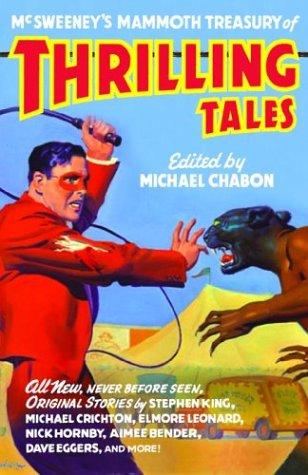
from McSweeney’s Mammoth Treasury of Thrilling Tales
In the introduction to this collection of short stories Michael Chabon, whose Pulitzer Prize-winning novel The Amazing Adventures of Kavelier & Clay I thoroughly enjoyed, posits that the “short fiction” of yester-year has been replaced with “the contemporary, quotidian, plotless, moment-of-truth revelatory story.” For the most part, I’d have to say that I agree with him. I love “The New Yorker” but I tend to skip their short fiction selections. Of course, I feel like a fat failure when I do but when I read a short story I tend to appreciate it more if it has a plot. This is why I enjoy reading anthologies of classic short stories that include selections like Shirley Jackson’s “The Lottery”, Kate Chopin’s “Story of an Hour”, or Guy de Maupassant’s “The Necklace.” It’s also the reason why I decided to try out Thrilling Tales.
As strange as it is, “Catskin” does satisfy the plot requirement…kind of. In a nutshell, – I think I can do this in less that three sentences – “Catskin” tells the story of a witch and her devoted son. For much of the story, the witch, who is actually dead and has consequently turned into a talking cat, and her son, who is dressed in a cat’s skin (don’t ask), journey to the house of Lack, the witch responsible for killing the ‘cat’ witch, seeking revenge. That would have been all well and good if the story hadn’t been so damn creepy and just plain odd. Take this selection for instance, a story the witch tells Small, her ten year-old son:
“A long time ago, when men and women were going to build a house, they would
dig a hole first. And they’d make a little room – a little, wooden, one-room house – in the hole. And they’d steal, or buy, a boy or a girl to put in the house in the hole, to live there. And then they built their house over that first little house…The boy or the girl stayed in that little house…They lived there all their life, and they are living in those houses still, under the other houses where the people live, and the people who live in the houses above may come and go as they please, and they don’t ever think about how there are little houses with children sitting in the little rooms, under their feet.”
The creepiest part of the tale above for me was not only its content but also that, in the world of “Catskin” it’s quite possible that it’s true. There's a scene in the story in which they actually open up one of the houses in a hole. Nothing comes out but I think Link wants readers to believe that it could. The creepiness of “Catskin” lies in that it plays upon the complete vulnerability of children. Children are kidnapped, abandoned, tossed into rivers, burned alive, and turned into captive kittens. I’m sure if I liked the story more, I could come up with something like “it’s-commenting-on-the-fragile-bonds-that-exist-between-parents-and-their-children” critical analysis – I was after all, an English major – but I don’t. I don’t like stories in which children seem to die just for the hell of it.
And the cats were just so damn creepy, ands I like cats! But after reading this story, I think I’ll be avoiding them for a while. Plus, I understand that in the world of “Catskin” we’re dealing with witches and magic so everything isn’t going to be explicable, but what was up with those gold bars miaowing, and how is a ten-year old boy dressed in a cat suit small enough to look like an actual cat? And what was up the red ants that spurted out of dead bodies carrying “pieces of time’ in their mouths? Okay, I get the metaphor but still, disturbing. And what happened to the ending in the story? It’s as if the writer got bored with her story and just ended it and purposely left the story and its readers with no resolution. How else do explain the last paragraph:
“The Princess Margaret grows up to kill witches and cats…There
is no such thing as witches, and there is no such thing as cats, either, only
people dressed up in catskin suits.”
Allll-right. And what was up with those damn cats?
Thursday, December 21, 2006
Pyongyang: A Journey in North Korea
Pyongyang: A Journey in North Korea
By Guy Delisle
from The Best American NonRequired Reading 2006
I generally never read comics. I don't have anything against comics at all, I just don't read them - I watch the cartoons. But if there are comics out there like this Delise selection then maybe I should start quick, fast, and in a hurry. Delise's account of his experience in the "ultra-secretive communist dynasty of North Korea" reminds me of my...interesting experience in China last year (that's a whole other long, painful story - Canon Powershot 700, I miss you wherever you are). But this isn't about me; it's about Delisle and his hilarious account of the "daily deification of Kim Jong Il" and the North Koreans who love him. Did I mention that this is all done with graphics? The "scene" in which he sees Kim Jong Il's face in the mirror instead of his own is hilarious. And there's a mystery too: what were the bags of rice for? And how in the world do two men with military training loose a sharp-shooting contest to a man who has never held a gun? If that were me, I'd have hung the bullseye on my wall too. Thank God I don't have any portraits of Kim Jong Il hanging there too.

